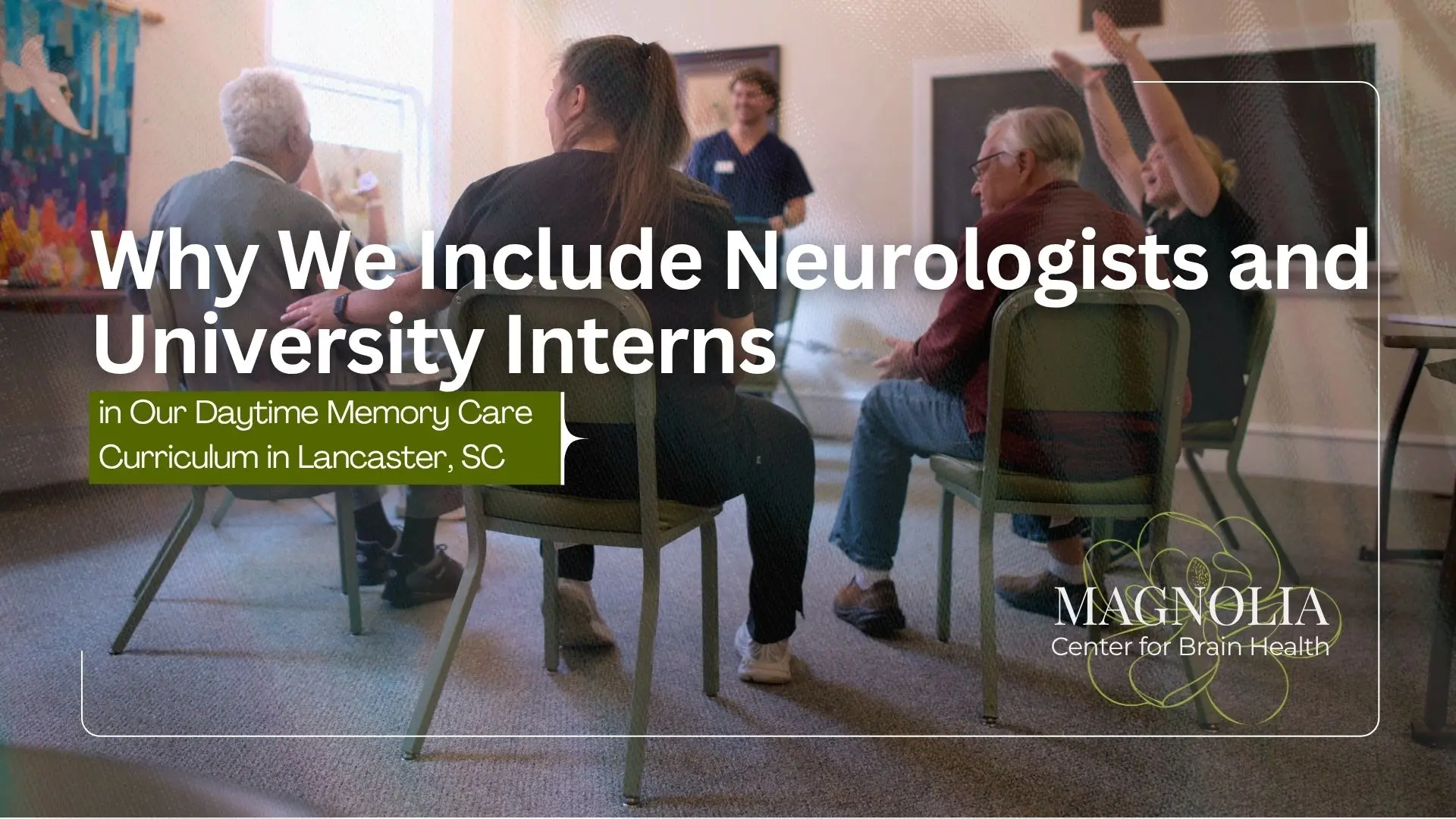
After a dementia diagnosis in Lancaster County, many South Carolina families find that generalized adult care centers are front-and-center in the search for answers and resources.
Although they go by a number of different names, adult enrichment centers have been the go-to for families in need of social supervision because they tend to be convenient. Unfortunately, convenience isn’t always a worthwhile tradeoff when a loved one is in cognitive decline.
Two Extremes Create a False Binary
A common point of confusion for adult children caring for loved ones with dementia is the assumption that daytime memory care falls into one of two extremes: either a basic custodial daycare or a cold, clinical hospital setting.
At the Magnolia Center for Brain Health, we’ve deliberately built a third model. Our non-residential support curriculum is therapeutically focused and driven by academic research, and yet beneath all of that, our programs are designed to be welcoming to all.
Our Dementia Support Programs Are a Place of Belonging
We’ve purposefully created home-like environments that sit on an academic and therapeutic foundation to provide support and resources for caregivers while uplifting those affected by memory care concerns.
Our participants receive active engagement with consulting neurologists, therapeutic guidance from experienced dementia care professionals, and direct partnerships with university intern teams. This makes our model decidedly different from traditional daycare, respite, and residential care programs in the area.
How Our Model Fits Your Lifestyle
If you’ve never explored this type of model, you may be unsure about how it differs from traditional daycare, and more importantly, how it can help you and your loved one stay comfortably at home. Understanding why we integrate higher therapeutic authority and academic partnerships into our sessions reveals why non-residential care may be a better option and why generalized adult daycare may not be enough.

The Limits of Social Adult Daycare
Traditional adult day programs are primarily designed around custodial supervision. They provide a safe space for seniors to spend a few hours and engage in casual group recreation while give primary caregivers receive a brief operational break.
All three of these elements are important, but even with these benefits, a traditional daycare may not be suited to address all of the various challenges that come along with cognitive challenges like dementia or Alzheimer’s.
Adult Daycare Facilities Do Not Care Any Less
This is not because these centers or their teams care less about families working through dementia. Instead, the setback often comes because staff members may lack specialized dementia training.
Activities tend to be generalized to offer enrichment to a wider array of needs and are usually structured around cognitive preservation, fine-motor skill retention, or sensory threshold management.
Because adult daycare centers typically need to cater to a wide variety of healthcare needs, they may not provide specialized care for individuals with memory care challenges. This may also result in activities like watching television that do not necessarily contribute to supporting brain health.
Unstructured Engagement Can Be Overwhelming
One of the other concerns here is that, over time, an individual with advancing memory loss may feel overwhelmed by unstructured, noisy environments. When this occurs, it may lead to anxiety, withdrawal, or behavioral changes.
Specialized memory care requires a different fundamental approach. Dementia is an evolving neurological condition, and supporting someone living with it comes along with the need for a structured, research-backed curriculum designed explicitly for cognitive impairment.
Bringing Science to Daily Support
One of the cornerstone differentiators of the Magnolia Center for Brain Health in Lancaster is the inclusion of specialized therapeutic expertise, such as consulting neurologists, directly within our operational framework.
We include neurological expertise not to turn our daytime center into a sterile clinic, but to ensure that every activity, conversation model, and environmental design point is grounded in the latest brain health research.
We also recognize that many caregivers have only consulted with primary care physicians or feel like they have been rushed through appointments with doctors who don’t always provide the detailed answers caregivers would like. Having the opportunity to meet in a group setting with a neurologist or other dementia specialist to discuss the unique circumstances of your care journey can make a world of difference.
How Neurological Authority Directs Our Program
The Magnolia Center for Brain Health, a part of Magnolia Memory Care Inc, is a purpose-built space for exploring the finer details about what’s taking place in your loved one’s life. We believe that having the opportunity to speak freely with a neurologist alongside other caregivers can help to put into context the challenges and successes you may face on a daily basis.
Curriculum Design Grounded in Neuroscience
The Magnolia Center for Brain Health places an emphasis on cognitive exercises, sensory integration tasks, and physical movement protocols that are crafted to stimulate neural pathways without causing sensory overload or cognitive fatigue.
Direct Caregiver Access to Medical Expertise
During our concurrent caregiver sessions in Lancaster, family members do not just sit in standard support circles. They gain direct access to visiting specialists, including neurologists, elder law attorneys, and care managers, to receive clear answers regarding disease progression, medication expectations, and long-term care strategies.
Bridging Therapeutic Knowledge and At-Home Care
Caregivers learn evidence-based behavior management techniques directly from experts. This empowers families to translate therapeutic strategies into daily home routines, reducing agitation, sundowning friction, and caregiver anxiety.
Injecting Youthful Energy and High-Ratio Engagement Through University Intern Partnerships
While healthcare authority provides the structural blueprint for caregiver support, executing our vision with warmth and individual focus requires a unique care workforce. The Magnolia Center for Brain Health operates as an active internship site for regional university students studying occupational therapy, gerontology, psychology, and pre-med disciplines.
This academic opportunity creates a powerful dynamic that traditional adult day programs cannot replicate.
The Benefits of Academic Partnerships
Exceptional 1-on-1 Attention
In many generalized senior settings, staff ratios are spread thin. Integrating university student interns allows our program to offer an extraordinary level of individual, one-on-one attention during every session.
Occupational Therapy Principles in Practice
Student interns working alongside our trained specialists are able to weave occupational therapy concepts into tactile crafts, fine-motor exercises, and movement routines. This focus is intentional and helps participants preserve their ability to perform daily tasks at home, fostering a sense of accomplishment and dignity.
Vibrant, Multi-Generational Connection
There is a joyful energy that shows up when university students sit down with our program participants. Rather than feeling like patients in a care setting, participants engage with energetic young adults who bring enthusiasm, curiosity, and genuine warmth to every conversation.
Invaluable Training
In return, university interns earn essential clinical hours under expert medical supervision, training the next generation of healthcare professionals to treat memory care with empathy, dignity, and therapeutic excellence.
Founded on Therapeutic Leadership, Driven by Compassion
This seamless blend of high-level science and deep personal empathy reflects the vision of our leadership. The Magnolia Center for Brain Health was founded and is guided by Susan Bill, a Registered Nurse (RN), Geriatric Care Manager, and Certified Dementia Practitioner (CDP).
Every staff member and student intern is specifically trained in dementia care dynamics, and we do not rely on casual, untrained volunteers for core engagement. This ensures that every shift in mood, every behavioral nuance, and every subtle physical change is met with calm, informed emotional intelligence.
Furthermore, our commitment to academic rigor means we actively collect and analyze data regarding program effectiveness, tracking metrics around participant engagement and caregiver stress reduction. This research edge ensures our curriculum continuously evolves based on proven outcomes.
High Therapeutic Standards in a Warm Local Environment
If you’re facing a diagnosis of Alzheimer’s or another form of dementia, you do not have to choose between a clinical facility that feels cold and a basic social daycare that lacks specialized dementia expertise.
The Magnolia Center for Brain Health bridges that gap for families across Lancaster, Indian Land, Fort Mill, Chester, Kershaw, and Waxhaw. Through our concurrent caregiver-participant program in Lancaster and our 4-hour Minds Matter respite program in Indian Land, we deliver research-backed memory support in spaces where participants feel celebrated, understood, and deeply valued.